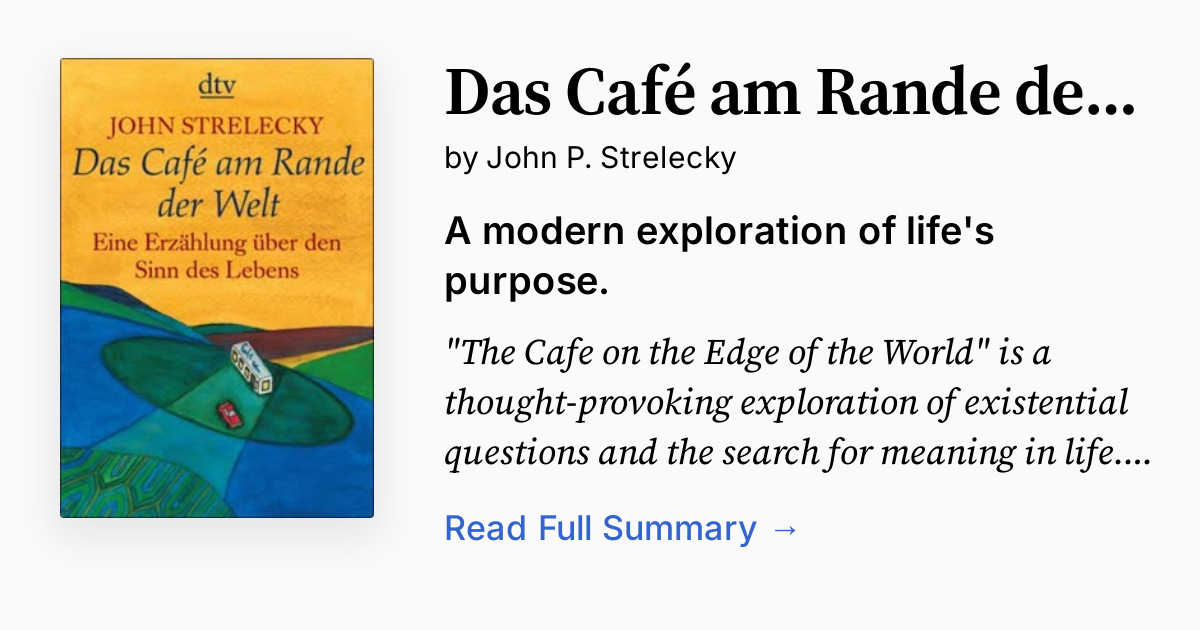
Self-Reflection & Purpose: Exploring Das Café Am Rande Der Welt
In a world often defined by relentless deadlines, digital distractions, and the constant pursuit of more, it's easy to lose sight of what truly matters. We often find ourselves on auto-pilot, navigating life's highways without ever pausing to consider our ultimate destination or the fuel that drives us. It is precisely this universal human experience that forms the compelling backdrop for John Strelecky's profound and meditative novel, Das Café Am Rande Der Welt (known in English as The Why Café).
More than just a story, John Strelecky's The Why Café: A Modern Guide to Finding Purpose offers a gentle yet powerful invitation to introspection, guiding readers toward a deeper understanding of their existence. This modern classic of spiritual philosophy, cherished globally and particularly appreciated by those who've read its original German, taps into our inherent desire to ponder life's big questions. Through a deceptively simple narrative, it challenges us to pause, reflect, and perhaps, reroute our journey towards a more authentic and fulfilling life.
The Unforeseen Detour: John's Journey to Self-Discovery
The story of Das Café Am Rande Der Welt begins with John, a quintessential overworked advertising executive, speeding towards what he hopes will be a much-needed vacation. His frantic pace, however, is abruptly halted when he finds himself stranded on a desolate road, out of gas and far from any familiar landmark. This unexpected inconvenience leads him to a small, unassuming establishment nestled "at the edge of the world"—a café that will irrevocably alter his perspective.
This remote café, seemingly a haven from the chaos of modern life, transcends its physical boundaries to become a metaphorical space for profound self-discovery. It's a place where the mundane turns magical, and an ordinary meal becomes an extraordinary journey into the self. John's initial frustration quickly gives way to curiosity as he encounters the café's intriguing menu, not of culinary delights, but of three fundamental questions designed to unlock the deepest layers of human purpose and satisfaction. This chance encounter, far from being a mere pit stop, becomes the catalyst for a life-altering transformation, echoing the idea that sometimes, getting lost is the only way to truly find yourself.
The Menu of Life: Three Questions That Unveil Your Core Purpose
The true heart of Das Café Am Rande Der Welt lies within the three deceptively simple, yet profoundly challenging, questions presented on its menu. These aren't just questions for John, the protagonist; they are a direct invitation to every reader to engage in a deeply personal dialogue with their own existence. The cafe's owner, Casey, along with the waitress Anne and a fellow patron Mike, guide John through a series of conversations that peel back layers of societal conditioning and personal anxieties, helping him confront these vital inquiries:
- "Why are you here?" This question strikes at the core of one's purpose for existence (the "Zweck der Existenz"). It compels us to look beyond daily routines and external achievements, urging us to identify our true passions, talents, and the unique contributions we are meant to make to the world. Are we living in alignment with our deepest values, or merely existing?
- "Do you fear death?" Often avoided, this question brings an acute awareness to the finite nature of life. Strelecky suggests that fear of death often stems not from the act of dying itself, but from the terrifying realization that we might not have truly lived. It's a powerful call to action, prompting us to evaluate if we are pursuing what truly matters, or postponing our dreams until "someday" that may never come.
- "Are you fulfilled?" This inquiry synthesizes the previous two, asking us to assess the quality of our present life. It pushes us to consider if our daily actions contribute to a sense of genuine contentment, joy, and purpose, or if we are merely chasing external markers of happiness that leave us feeling empty. Fulfillment isn't about having everything, but about truly experiencing the richness of life.
These questions serve as a powerful framework for introspection, designed to challenge assumptions and ignite a personal quest for meaning. For a deeper dive into how these inquiries can transform your perspective, explore Das Café am Rande der Welt: Three Questions That Change Your Life.
Beyond the Narrative: Key Philosophical Pillars of Das Café Am Rande Der Welt
While the story of Das Café Am Rande Der Welt is engaging, its enduring appeal stems from the accessible philosophical truths it imparts. Strelecky masterfully weaves profound life lessons into an approachable narrative, making complex ideas resonate with readers from all walks of life. Several key philosophical pillars underpin the book's transformative message:
- The Imperative of Purpose (Zweck der Existenz): The book argues that every individual has a unique purpose, and neglecting to discover or live it leads to a sense of emptiness. Finding this purpose is not a luxury but a fundamental human need, guiding our decisions and shaping our fulfillment.
- Time as a Finite Resource: A recurring theme is the precious, non-renewable nature of time. The book gently reminds us that life is finite, and every moment is an opportunity to align our actions with our deepest desires, rather than waiting for an elusive "perfect" moment.
- Self-Determination and Choice:
Das Café Am Rande Der Welt emphasizes that we are not passive recipients of our fate. We have the power to choose our path, make decisions, and actively shape our reality, regardless of external circumstances. Our choices, conscious or unconscious, define our journey. - Challenging Societal Expectations: Many find themselves trapped by societal norms, striving for external validation or material possessions they believe will bring happiness. The book encourages readers to critically examine these expectations and align their lives with their authentic values, not those imposed by others.
- Mindfulness and Presence: Living an unfulfilled life often means being distracted from the present moment. The story subtly advocates for mindfulness—the ability to be fully present, to truly experience and appreciate life as it unfolds, rather than constantly dwelling on the past or worrying about the future.
- Personal Responsibility for Happiness: Ultimately, the book reinforces that our happiness is our own responsibility. While external factors play a role, true contentment comes from within, cultivated through self-awareness, intentional choices, and a commitment to living authentically.
These teachings, though not entirely new, are presented in a manner that feels personal, inviting, and deeply impactful, making them resonate long after the final page is turned.
Integrating Wisdom: Practical Steps for Your Own Self-Reflection Journey
The beauty of Das Café Am Rande Der Welt isn't just in its narrative, but in its ability to spark real-world change. John Strelecky's framework can be a powerful starting point for your own journey of self-discovery. Here are some actionable steps you can take to integrate these profound insights into your daily life:
- Journaling the Three Questions: Dedicate specific time each week to write down your honest answers to "Why are you here?", "Do you fear death?", and "Are you fulfilled?". Don't censor yourself; let your thoughts flow freely. Revisit your answers over time to track your evolving understanding.
- Identify Your "Zweck der Existenz": What truly ignites your passion? What activities make you lose track of time? What problems do you feel compelled to solve? Begin to map out what your unique purpose might look like, whether it's through your career, hobbies, or community involvement.
- Perform a "Values Audit": List your top 5-7 core values (e.g., freedom, creativity, connection, security, learning). Then, honestly assess how well your current life choices, relationships, and daily activities align with these values. Where are the discrepancies?
- Confront Your Fears and Regrets: Use the "Do you fear death?" question as a prompt to identify unfulfilled desires or actions you might regret not taking. What can you start doing *today* to mitigate future regret? This could be a small step towards a big dream.
- Practice Mindful Pauses: Integrate short moments of mindfulness into your day. Whether it's a few deep breaths before starting a task, savoring a meal without distraction, or simply observing your surroundings during a walk, these pauses help you stay present and connected to your inner self.
- Challenge Societal Norms: Actively question the "shoulds" and "musts" dictated by external pressures. Ask yourself if these expectations genuinely align with your own aspirations for fulfillment. Give yourself permission to forge your own path.
- Create Your Own "Café of Reflection": Find a quiet, personal space—be it a favorite armchair, a park bench, or a secluded corner of a real café—where you can regularly disconnect from distractions and engage in focused self-reflection.
By consciously engaging with these principles, you can begin to transform your abstract understanding into tangible steps towards a life rich with purpose and genuine fulfillment.
Conclusion
Das Café Am Rande Der Welt is more than just a book; it's an experience, a conversation starter, and a gentle mirror held up to our own lives. John Strelecky's masterful storytelling, imbued with both simplicity and profound wisdom, offers a timeless reminder that the answers to life's biggest questions aren't found in a hidden treasure map, but within ourselves. Through the journey of John and the guidance of the enigmatic café, readers are empowered to challenge their assumptions, define their purpose, and consciously craft a life that resonates with their deepest desires. It's an essential read for anyone feeling adrift, searching for meaning, or simply needing a gentle nudge to remember why they are truly here.